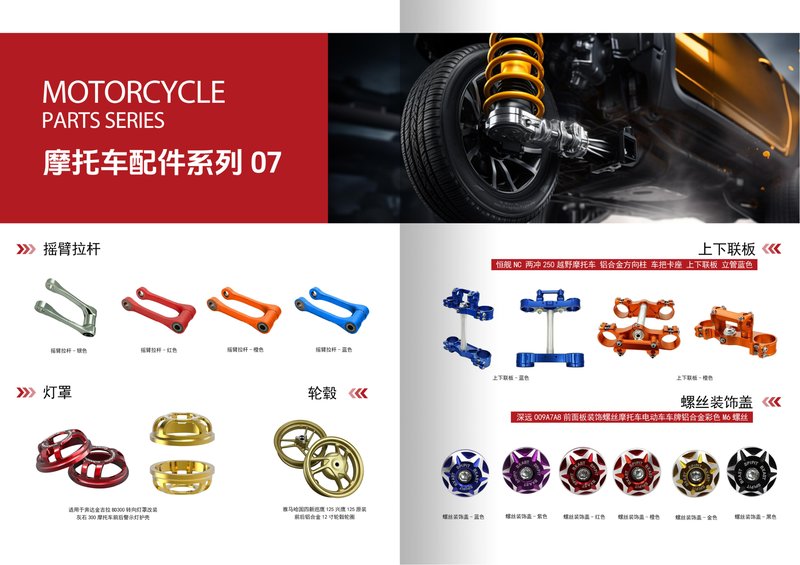
Motorcycle frame connectors are among the most safety-critical components on any bike. They link the steering head, swingarm pivot, and engine cradle, so they must handle constant vibration, cornering loads, and impact stress. For brands and workshops sourcing these parts, understanding how they are made is the first step toward better purchasing decisions. This guide from Fuxingwang Hardware Products Co., Ltd. explains how CNC machining turns raw aluminum and steel billets into reliable motorcycle frame connectors.

Why Frame Connectors Demand Precision CNC Parts
A frame connector is not a simple bracket. It often carries multiple mounting holes, machined faces, and tight tolerances that keep the frame geometry accurate. If a connector is off by even 0.1 mm, the swingarm pivot can misalign, causing uneven tire wear or unstable handling.
That is why most modern connectors are produced as precision CNC parts rather than castings or weldments. CNC machining removes material with controlled accuracy, producing repeatable dimensions across every unit in a production run. For a motorcycle parts manufacturer, this repeatability is essential for warranty control and rider safety.
Materials Used for Motorcycle Frame Connectors
Material choice affects strength, weight, and cost. Common options include:
- 6061-T6 aluminum: Lightweight, corrosion-resistant, and easy to machine. Ideal for street and custom builds.
- 7075 aluminum: Higher strength-to-weight ratio for racing and off-road applications.
- 4130 chromoly steel: Excellent fatigue resistance for heavy-duty and vintage frames.
- Stainless steel 304/316: Used where corrosion resistance matters more than weight.
Each material behaves differently during cutting. Aluminum allows faster spindle speeds, while chromoly steel requires slower feeds and more rigid tooling to avoid work hardening.
The CNC Machining Process for Frame Connectors
1. Design Review and DFM Analysis
Before cutting metal, engineers review the 3D model or 2D drawing. They check wall thickness, hole depths, and tool reach. Design for manufacturability (DFM) feedback at this stage prevents costly revisions later.
2. Fixture and Workholding Setup
Frame connectors are often asymmetrical, so custom fixtures are machined to hold the part securely. Proper workholding reduces vibration and protects surface finish on visible faces.
3. Roughing and Finishing
Roughing passes remove most of the material quickly. Finishing passes then achieve the final tolerances and surface finish. On a 3-axis or 4-axis vertical machining center, this can be done in two or three setups. More complex connectors may require 5-axis machining to reach angled faces in one cycle.
4. Drilling, Tapping, and Boring
Mounting holes are drilled and tapped to specification. Pivot bores are often bored or reamed to achieve a precise fit for bearings or bushings. Threads are checked with go/no-go gauges.
5. Deburring and Surface Treatment
After machining, parts are deburred by hand or in a vibratory tumbler. Aluminum connectors are commonly anodized for corrosion protection and color. Steel parts may be black oxide coated, zinc plated, or powder coated.
Quality Control for Precision CNC Parts
At a reliable motorcycle parts manufacturer, quality control is built into every step. First-article inspection (FAI) confirms the setup before mass production. In-process checks catch tool wear. Final inspection uses calipers, micrometers, height gauges, and CMM equipment to verify critical dimensions.
For frame connectors, the most important checks include:
- Pivot bore diameter and concentricity
- Mounting hole positions relative to datum surfaces
- Flatness of mating faces
- Thread depth and pitch
- Surface finish on bearing seats
Documented inspection reports give buyers traceability and confidence.
Working with a Custom CNC Machining China Partner
Many international brands choose custom CNC machining China for frame connectors because it offers a balance of cost, speed, and capability. However, not every supplier is equal. Look for a factory with:
- In-house machining, not just trading
- Experience with motorcycle and powersports parts
- Clear communication and English-speaking engineering support
- Documented quality processes
- Ability to handle low-volume prototypes and high-volume production
Fuxingwang Hardware Products Co., Ltd. (Jiangmen Fuxingwang Hardware) was founded in 2012 and operates a 2,000 sqm factory with more than 100 CNC machines. The company specializes in motorcycle parts and custom CNC machining, serving clients who need dependable precision CNC parts at competitive prices. From prototype to production, the team supports material selection, DFM feedback, and surface finishing.
Common Applications for CNC Machined Frame Connectors
These parts appear across many motorcycle categories:
- Sport bikes and track bikes needing lightweight aluminum connectors
- Adventure and dual-sport bikes requiring robust steel or aluminum designs
- Cruisers and custom builds with unique frame geometry
- Electric motorcycles and scooters with compact frame layouts
- Aftermarket frame kits and restoration projects
Because CNC machining is flexible, custom designs can be produced without expensive tooling. That makes it practical for small batches as well as large orders.
Conclusion: Source Frame Connectors with Confidence
Motorcycle frame connectors are small parts with big responsibilities. Choosing a manufacturer that understands tolerances, materials, and quality control protects your brand and your riders. Whether you need a few prototypes or thousands of units, working with an experienced motorcycle parts manufacturer ensures your connectors fit and perform as designed.
Ready to start your project? Send your drawings or 3D files to Fuxingwang Hardware for a free quote. Our engineering team will review your design, suggest improvements, and provide a clear price and lead time. Contact us today to discuss your custom CNC machining needs.